Time-Delay Filters
This section describes the time shift properties of the WDM wavelets. This is based on the results in section 4 of Ref. [1] .
Introduction
The WDM wavelets \(\{g_{nm}(t)|n\in\{0,1,\ldots,N_t-f\}, m\in\{0,1,\ldots,N_f-1\}\}\) form a complete basis, meaning that any time series can be expanded in terms of these wavelets. In particular, if we take a single wavelet and shift it in time, \(g_{nm}(t+\delta t)\) we can rexpand this in terms of the original, unshifted wavelet basis. The coefficients of this expansion are given by the overlap integrals
These coefficients are called the time-delay matrix elements. They can be written as an integral over frequency;
Most of the \(X_{nn';mm'}(\delta t)\) coefficients are zero because the wavelets \(\tilde{G}_{nm}(f)\) have compact support in the frequency domain and the integral will vanish unless the wavelets overlap.; the only non-zero coefficients are those for which \(m'=m\) or \(m'=m\pm 1\). In the general case when \(m\neq 0\) and \(m'\neq 0\), these integrals evaluate to give (the following results are derived in the section below)
where the time-delay filters \(T_{\ell}(\delta t)\) and \(T'_{\ell}(\delta t)\) are defined as
The time-delay filters \(T_{\ell}(\delta t)\) and \(T'_{\ell}(\delta t)\) are implemented in
WDM.code.time_delay_filters.filters.time_delay_filter_Tl() and
WDM.code.time_delay_filters.filters.time_delay_filter_Tl_prime() respectively.
The full time-delay matrix elements \(X_{nn';mm'}(\delta t)\) are implemented in
WDM.code.time_delay_filters.filters.time_delay_X().
These functions can be precomputed and interpolated for efficient use later. As can be seen from the plots in Figure 7, these time-delay filters only need to be interpolated in the narrow range \(0\leq \delta t < 2\Delta T\).
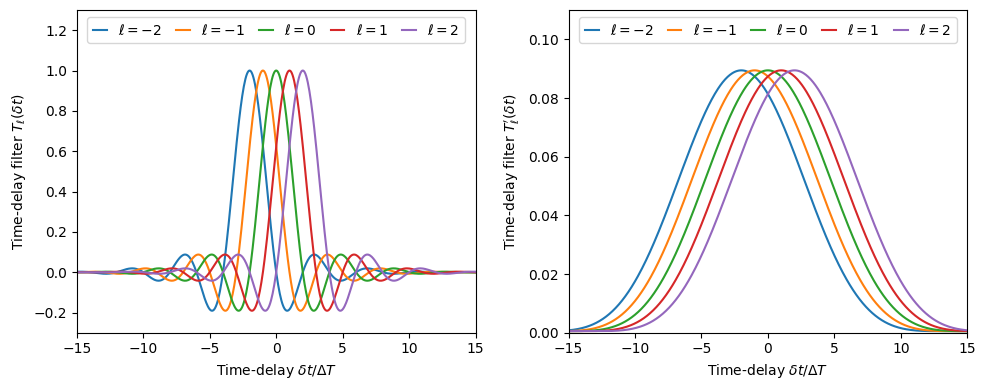
Figure 7 The time-delay filter functions \(T_\ell(\delta t)\) (left) and \(T'_\ell(\delta t)\) (right) plotted as a function of \(\delta t\) for several values of \(\ell\).
Derivation
This section contains a derivation of the results in Eqs. (40) to (43) above.
Start from the definition of the time-delay matrix elements in the frequency domain in Eq. (39).
First consider the case \(m'=m\) (and assume that \(m>0\)). Using the frequency-domain definition of the WDM wavelets
gives
Using the fact that wavelets have compact support in frequency and the fact that \(m>0\), only the first and last terms in the square brackets are non-zero. Changing variables in the integrals to centre all the window functions around zero frequency gives
Using \(\Delta F \Delta T = 1/2\) gives
In the second integral, change the integration variable \(f\to -f\) to get
where the time-delay filter \(T_{\ell}(\delta t)\) is defined as above. This is the desired result for \(m'=m\).
The case \(m'=m\pm 1\) can be derived in a similar manner.